Leadership
·7 min readSystems Leadership: Building StaffyTalent, High-Throughput Pipelines, and AI Tooling
Bio: Founder of StaffyTalent LLC | B.S. Computer Science | Systems Architect based in Georgetown, TX | Building DeepScout, data pipelines, and AI tooling.
CL
Christopher Lazok
Founder & Systems Architect · Georgetown, TX
True technical leadership is not exercised from detached executive suites or abstract diagrams—it is earned in the trenches where systems design meets real-world execution. As a computer scientist and systems architect, my career has been defined by a simple principle: the best leaders build.
Whether founding StaffyTalent LLC to revolutionize technical talent acquisition, architecting high-throughput data pipelines that process millions of records with sub-second latency, or engineering DeepScout to push the boundaries of desktop analytics and local neural AI, leadership is about setting technical standards and delivering tangible value.

On-site operational leadership: bridging technical architecture with field execution.
1. The Foundation: Computer Science & Systems Architecture
Holding a B.S. in Computer Science provides the rigorous algorithmic and architectural bedrock needed to navigate complex distributed systems. In modern engineering organizations, technology stacks rapidly evolve—from legacy monolithic relational databases to cloud-native microservices, columnar analytics engines, and edge neural networks.
Operating out of Georgetown, Texas, at the heart of the Central Texas tech corridor, my architectural philosophy centers on:
- Algorithmic Correctness Before Scale: Optimizing database schemas, indexing strategies, and computational memory layouts before throwing brute-force cloud compute at inefficient queries.
- Resilience Over Novelty: Preferring battle-tested, offline-capable, and embedded architectures (such as DuckDB, SQLite WAL mode, and MinGW-optimized native binaries) over fragile, high-overhead frameworks.
- Measurable Key Performance Indicators (KPIs): Establishing hard empirical benchmarks—query latency, I/O throughput, token consumption rates, and worker core utilization.
2. Founding StaffyTalent LLC: Rethinking Technical Talent
Recognizing widespread inefficiencies in enterprise hiring, I founded StaffyTalent LLC with a clear mission: eliminate the disconnect between corporate hiring teams and elite technical contributors.
Traditional staffing agencies treat technical recruitment as a keyword-matching game. Non-technical recruiters filter out high-impact systems architects simply because resume buzzwords do not align with arbitrary checklists.
At StaffyTalent LLC, we restructured the engagement model:
- Architect-Led Technical Evaluation: Every candidate is evaluated by experienced technologists who understand compiler optimizations, data structures, and distributed state machines.
- Transparent Incentive Alignment: Ensuring engineers are compensated directly for their technical impact rather than having their value siphoned by predatory staffing layers.
- Culture of Craftsmanship: Prioritizing candidates with public portfolios, verified open-source contributions, and demonstrated mastery of end-to-end delivery.
3. High-Throughput Data Pipelines: Zero-Bottleneck Infrastructure
Data pipelines are the cardiovascular system of modern enterprises. If ingestion stalls or data transformations corrupt upstream state, every analytical dashboard, ML model, and operational decision fails downstream.
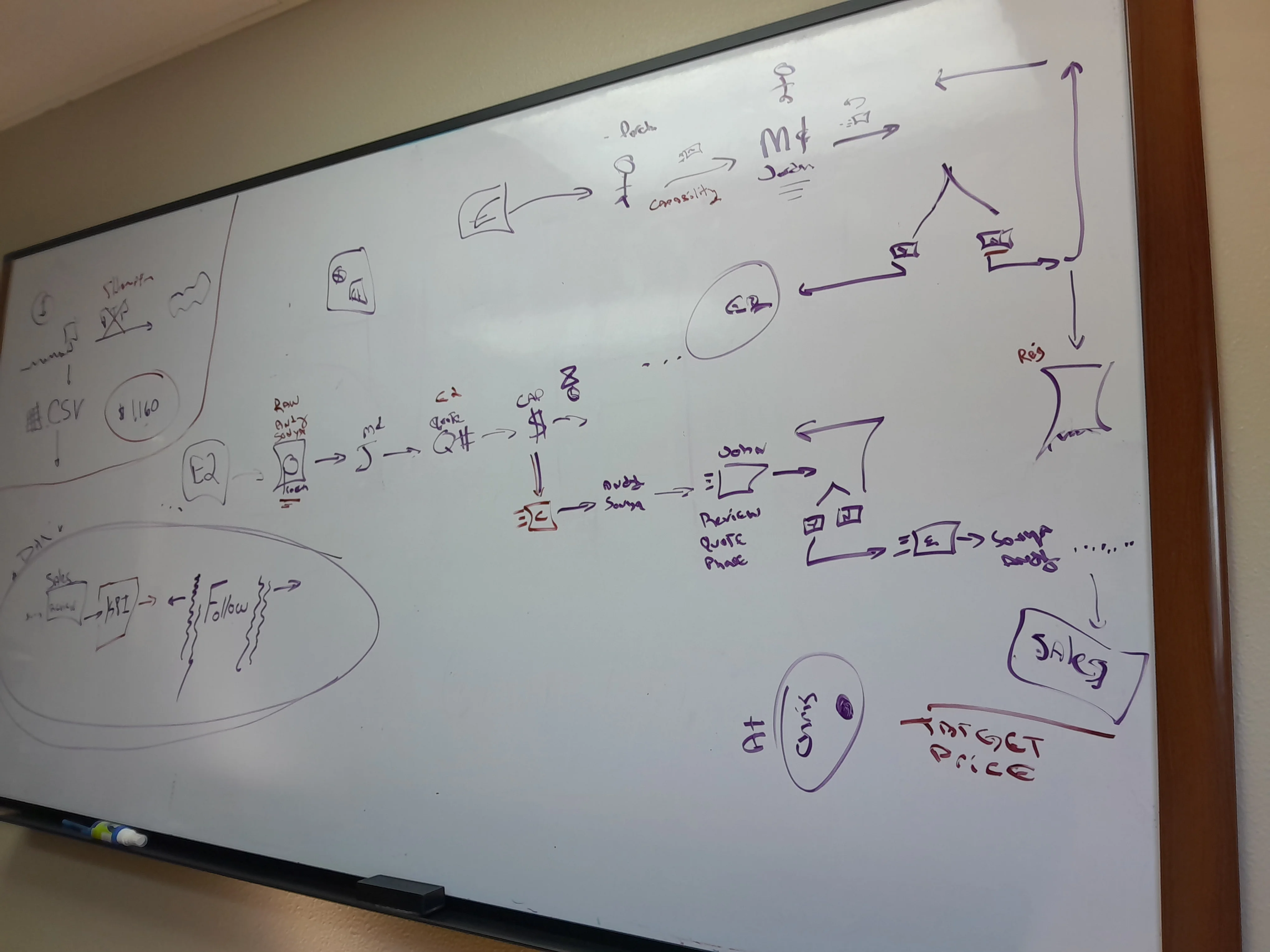
Whiteboard architecture session: mapping ingestion topologies, ETL transformations, and event-driven data flows.
When designing enterprise data infrastructure, our architectural playbook prioritizes:
- Stream-First Ingestion with Backpressure: Designing asynchronous queues that absorb high-velocity ingest bursts without crashing downstream persistence nodes.
- Columnar Acceleration: Leveraging vectorized columnar query engines (such as DuckDB and Apache Arrow) to query parquet archives at rates exceeding 100M rows per second per node.
- Strict Normalization Where It Matters: Employing Boyce-Codd Normal Form (BCNF) across financial and operational ledgers to guarantee zero redundancy, while using denormalized read-models for ultra-fast customer-facing interfaces.
4. DeepScout: Vectorized Analytics & Neural Engine Integration
As the creator of DeepScout, I wanted to prove that desktop analytical platforms could match or exceed the speed of enterprise cloud clusters without requiring internet connectivity or third-party server infrastructure.
DeepScout is a native desktop chess database and interactive sparring arena engineered to bridge high-volume historical game storage with modern AI evaluation:
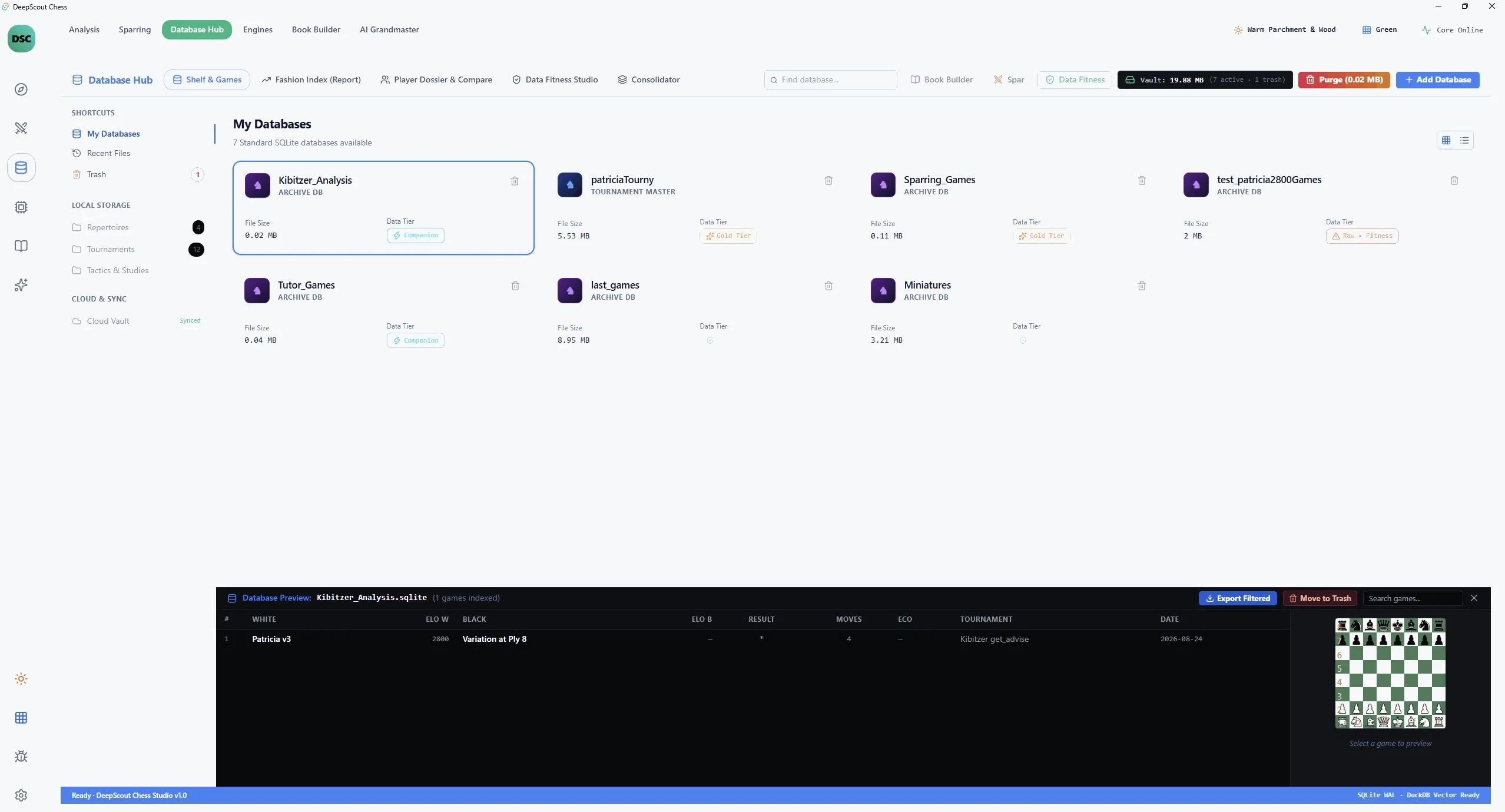
DeepScout Chess Database Hub: dual-engine management combining SQLite WAL persistence with DuckDB vectorized analytics.
Architectural Highlights of DeepScout:
- DuckDB Columnar Core: Executes sub-second OLAP position lookups, move frequency calculations, and player win-rate statistics across multi-million game collections.
- Dual-Engine UCI Protocol Bridge: Interfaces concurrently with Stockfish 18 (evaluating tactical depth and minimax tree search) and Leela Chess Zero (Lc0) (evaluating neural network positional weights via CUDA/DirectML).
- Polyglot Binary Opening Trees: Generates opening repertoire move trees with interval evaluation verification.
5. Modern AI Tooling & Local Inference Architectures
The rise of large language models (LLMs) has introduced extraordinary capabilities—and extraordinary cloud costs. A critical aspect of my architectural research has been designing offline-first and Bring-Your-Own-Key (BYOK) AI tooling that preserves user privacy and eliminates runaway SaaS fees.
In DeepScout, we introduced the AI Grandmaster Lab, integrating local LLM runtimes (via LM Studio) to provide contextual, strategic Grandmaster coaching during live sparring games:
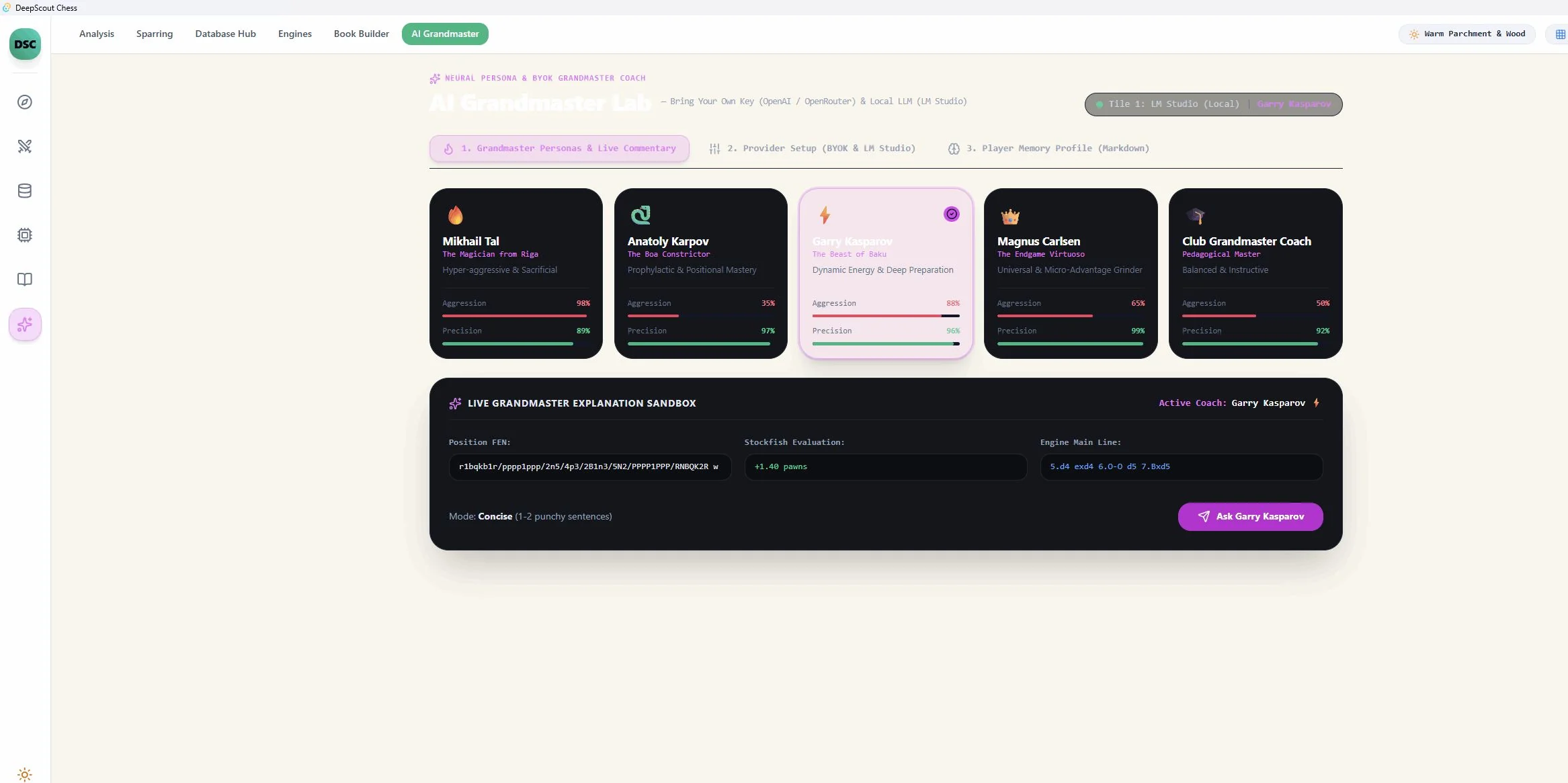
AI Persona Lab: local LLM inference engines providing real-time grandmaster evaluation commentary.
By piping engine evaluation streams directly into local quantized models, we achieve sub-second personality coaching without sending a single byte over the public internet.
6. Core Tenets of Technical Leadership
Reflecting on founding businesses, leading systems architecture, and maintaining public open-source software, three principles remain paramount:
1. Maintain Technical Currency
A leader who stops coding rapidly becomes an architectural bottleneck. To evaluate engineering trade-offs, you must understand memory allocation, container virtualization, and modern API interfaces firsthand.
2. Radical Transparency & Open Source
Good software compounds. By contributing to open-source software—including chess engines, Model Context Protocol (MCP) servers, and developer tooling on GitHub (@tidypy)—we pay forward the mentorship and shared knowledge that made our own careers possible.
3. Build for People First
Whether mentoring an emerging engineer in Georgetown, Texas, or delivering mission-critical infrastructure for enterprise clients at StaffyTalent LLC, technology exists to serve human agency, economic opportunity, and community resilience.