Blaze ASR: Engineering the Fastest Local Whisper & GGUF Desktop Transcription Pipeline
An in-depth architectural breakdown of Blaze ASR: achieving up to 82.6x RTFx throughput with zero PyTorch bloat, native Qt6, CTranslate2, GGUF models, and built-in Model Context Protocol (MCP) server integration.
The Problem: Cloud Lock-in and Framework Bloat in Local Speech-to-Text
Audio transcription has become foundational to executive workflows, developer note-taking, legal audits, and enterprise knowledge extraction. However, anyone attempting to deploy speech-to-text models locally encounters immediate architectural hurdles:
- Cloud Costs & Privacy Exposure: Cloud transcription APIs (OpenAI Whisper API, AWS Transcribe, Rev.ai) meter audio by the minute. For companies processing internal meetings, legal interviews, or proprietary strategy sessions, sending unencrypted audio over external networks introduces critical compliance and security risks.
- Massive Python & PyTorch Runtime Bloat: Typical desktop transcription utilities bundle full Python
torchandtorchaudiodistributions, adding 2.5 GB to 4.5 GB+ of unnecessary disk and memory footprint. Layering an Electron or Chromium wrapper on top consumes another 400 MB to 900 MB of idle RAM before any inference occurs. - Severe Memory Spikes & Out-of-Memory (OOM) Failures: Conventional audio processing scripts load entire media files into 16-bit integer arrays, then duplicate them into 32-bit floating-point buffers—creating a catastrophic 2x memory spike. During long recordings, CUDA processes frequently crash with unrecoverable
CUDA out of memoryerrors, destroying hours of queued work.
To eliminate these compromises, I built Blaze ASR: a free and open-source (FOSS), ultra-low-memory, GPU-accelerated desktop transcription application engineered to be the fastest local Whisper & GGUF ASR desktop pipeline on the planet.
⚡ Performance & Memory Benchmarks
By eliminating the multi-gigabyte PyTorch runtime, streaming audio in 64 KB native f32le chunks, and executing fused C++/CUDA kernels with INT8 and FP16 quantization, Blaze ASR delivers 4x to 8x faster throughput while using 50% to 70% less RAM and VRAM than standard Whisper implementations:
Engine Speed, VRAM & Accuracy Matrix
| Engine & Model | Approx. VRAM | Throughput (RTFx) | 1 Hour Audio Transcribed In | Accuracy (WER) |
| :--- | :---: | :---: | :---: | :---: |
| Faster-Whisper (Tiny) | ~600 MB | ~82.6x RTFx | ~43 sec (0.73s / min) | 6.65% |
| Faster-Whisper (Base) | ~800 MB | ~68.2x RTFx | ~53 sec (0.88s / min) | ~5–7% |
| Cohere Q8 (GGUF + Diarization) | ~1.8 GB | ~27.9x RTFx | ~2 min 09 sec | 16.08% (2,620-file LibriSpeech) |
| Cohere F16 (GGUF + Diarization) | ~3.0 GB | ~18.5x RTFx | ~3 min 14 sec | ~5.00% |
| Faster-Whisper (Large-v3) | ~3.5 GB (or <2.2 GB INT8) | ~15.0x RTFx | ~4 min 00 sec | SOTA (Broadcast Grade) |
Real-Time Factor (RTFx) measures execution speed relative to playback duration. At 82.6x RTFx, an entire 60-minute audio track is fully transcribed and timestamped in just 43 seconds.
🏗️ Architectural Breakdown: Standard GUIs vs. Blaze ASR
| Bottleneck | Standard Whisper / Electron GUIs | Blaze ASR Architecture |
| :--- | :--- | :--- |
| ML Runtime Footprint | 2.5–4.5 GB+ Python torch / torchaudio overhead | 0 MB PyTorch overhead — pure C++ CTranslate2 & native crispasr CUDA |
| Audio Decode RAM | Decodes full int16 buffer + copies float32 array (2x RAM spike) | 50% less peak decode RAM via streaming 64 KB native f32le pipes |
| UI Framework RAM | 400–900 MB idle Chromium / Electron renderer | ~65–110 MB idle native C++ Qt6 (PySide6) + <10 ms launch |
| Batch Queue Overhead | Reloads multi-GB model weights per file | Single-load VRAM persistence (0s reload across 100+ queued files) |
| Tight VRAM Resilience | Crashes with CUDA out of memory | Auto OOM step-down (float16 → int8_float16 → int8 → cpu) |
| Post-Analysis Insights | Heavy LLM SDKs or cloud-locked pipelines | ~0.8s–2.8s stdlib HTTPS (gemini-3.5-flash-lite / NIM / Fireworks / Local) |
┌────────────────────────────────────────────────────────────────────────┐
│                        Blaze ASR Desktop Engine                        │
├────────────────────────────────────────────────────────────────────────┤
│  Native PySide6 (Qt6) GUI  [~65-110 MB RAM | <10ms launch | Dark/Light]│
├────────────────────────────────────────────────────────────────────────┤
│               Audio Stream Pipeline (FFmpeg 64 KB f32le)               │
├──────────────────────────────────┬─────────────────────────────────────┤
│   Dual GPU Engine Pipeline 1     │     Dual GPU Engine Pipeline 2      │
│   Faster-Whisper (CTranslate2)   │     CrispASR (GGUF / C++ CUDA)      │
│   - INT8 / FP16 Quantization     │     - Cohere Transcribe / Parakeet  │
│   - Auto OOM Step-Down Failover  │     - Native Speaker Diarization    │
├──────────────────────────────────┴─────────────────────────────────────┤
│    Post-Processing & Output Formats (.srt, .vtt, .txt, .md, .json)     │
│    - Speaker-Aware Timestamp Grouping (1s, 5s, 10s, 30s, 60s, 30m)     │
│    - Automated <10 MB Chunking for RAG / LLM Ingestion                 │
├────────────────────────────────────────────────────────────────────────┤
│          Post-Analysis BYOK AI Insights (DPAPI Encrypted)              │
│          - Google Gemini (Flash-Lite auto-failover, AIza / AQ keys)    │
│          - NVIDIA NIM, Fireworks.ai, Local Ollama / LM Studio          │
├────────────────────────────────────────────────────────────────────────┤
│          Model Context Protocol Bridge (--mcp-server)                  │
│          - stdio JSON-RPC 2.0 server for Claude, Antigravity, Cursor   │
└────────────────────────────────────────────────────────────────────────┘
🔑 Key Engineering Highlights
1. Dual Local GPU Engines with Auto OOM Step-Down
Blaze ASR combines two specialized local C++ inference engines:
- Faster-Whisper (
CTranslate2): Optimized for OpenAI Whisper architectures using fused INT8 and FP16 CUDA kernels. Blaze ASR incorporates an Automated OOM Step-Down State Machine:float16→int8_float16→int8→cpuWhen transcribing long or dense audio files on limited-VRAM GPUs (e.g. 4 GB–8 GB cards), the engine gracefully steps down precision dynamically rather than terminating with a CUDA memory crash. - Cohere & GGUF ASR (
CrispASR): Direct native C++/CUDA inference for.ggufspeech models (including Cohere Transcribe and NVIDIA Parakeet), featuring integrated speaker diarization, millisecond-precision JSON timestamps (-oj), and character-proportional duration interpolation for untimed output tokens.
2. Streaming Audio Pipeline (64 KB f32le Buffers)
Standard audio loading routines in Python load the entire audio file into memory, decode it to 16-bit PCM integer samples, and then perform a second in-memory allocation to cast those samples to 32-bit floats. For a 3-hour podcast or conference recording, this creates a massive multi-gigabyte memory spike.
Blaze ASR pipes raw audio through a sandboxed ffmpeg process directly as a stream of 64 KB native f32le chunks. Memory consumption remains flat regardless of whether the source file is 2 minutes or 6 hours long.
3. Bulk Batch Queue with Single-Load VRAM Persistence
Dragging 50 video and audio files into Blaze ASR loads the neural network weights into GPU memory exactly once. Across the entire queue:
- Zero Reload Overhead: Subsequent files begin transcribing within milliseconds.
- Per-File Fault Isolation: If a single file in the queue has corrupted audio frames or an unreadable container, Blaze ASR logs the error, isolates the failure, and immediately advances to the next item in the queue.
- Instant Cancel + Save-on-Cancel (
_PARTIAL): Cancelling a marathon job immediately terminates active subprocesses and writes all transcribed segments up to that second as<filename>_PARTIAL.<ext>so no work is lost.
4. 6 Export Formats & Automated <10 MB RAG Chunking
Blaze ASR exports into six distinct formats simultaneously:
.srt&.vtt: SubRip and WebVTT caption tracks..vtt.txt: WebVTT syntax saved with a.txtextension, enabling seamless upload to CRM, legal, and AI systems that reject.vttfile extensions..txt: Clean, untimed prose..md: Structured Markdown formatted with an entity metadata header..json: Typedblaze_asr_transcript_v1schema containing per-word and per-segment confidence scores and timestamps.
Furthermore, Blaze ASR features Speaker-Aware Timestamp Grouping (None, 1s, 5s, 10s, 30s, 60s, 120s, 30m), which merges adjacent phrases within temporal windows without ever combining speech across distinct speaker turns. Marathon transcripts are automatically split into <10 MB parts (_part_001_of_N) to prevent payload rejections in downstream LLM and vector RAG pipelines.
🖼️ User Interface & Workflow Gallery
Blaze ASR features a clean, high-contrast native Qt6 GUI supporting instantaneous toggle between GitHub Primer Dark (#0d1117) and Clean Light (#f6f8fa) themes:
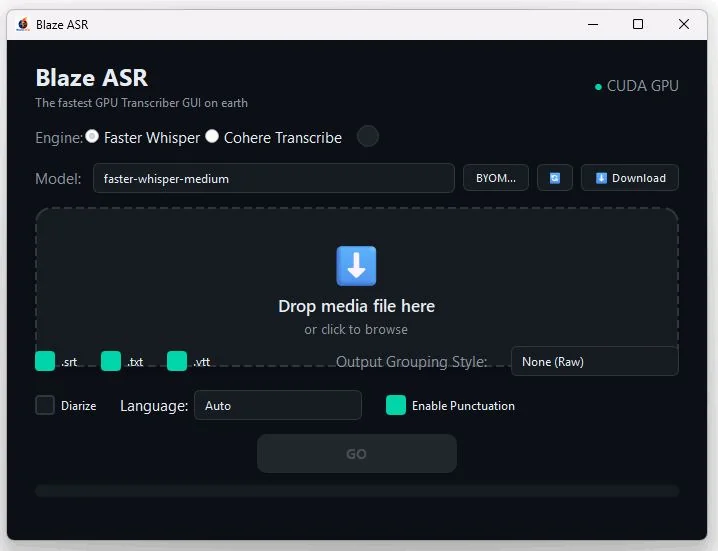
Desktop Interface
Batch Queue & Model Selection
Drag-and-drop batch processing queue with real-time RTFx velocity meters.
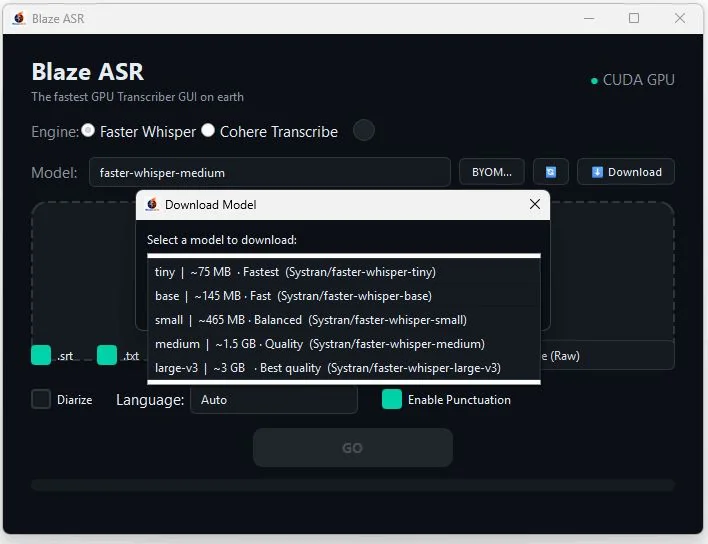
Model Manager
1-Click Systran Faster-Whisper Downloader
Download verified Tiny, Base, Small, Medium, and Large-v3 model weights directly.
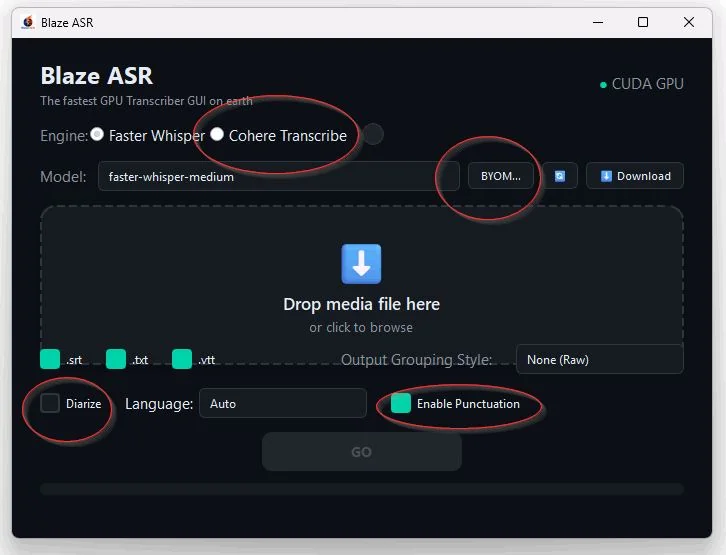
Advanced Controls
BYOM & Speaker Diarization
Point to existing GGUF or CTranslate2 weights without duplicating storage.

Portable Distribution
Zero-Config Self-Contained Binary
Bundled NuGet Python 3.11, sandboxed FFmpeg, and CUDA runtime DLLs.
🤖 Post-Transcription BYOK AI Insights & OS-Level Key Security
While raw transcripts remain 100% immutable and pristine, Blaze ASR includes an optional ✨ AI Insights engine. When activated, the engine analyzes completed transcripts and outputs separate <stem>_insights.md and <stem>_insights.json files containing:
- Executive Summary & Core Narrative
- Speaker Intentions & Sentiment Mapping
- Key Claims, Decisions, and Risk Factors
- Action Items with Assigned Owners
Zero-Dependency HTTPS Client with Auto-Healing Gemini
Rather than pulling in heavy third-party SDKs, Blaze ASR's AI Insights engine is written using Python's standard library over secure HTTPS sockets. It features out-of-the-box presets for:
- Google Gemini: Supports both standard
AIza…API keys and Vertex AI ExpressAQ.…credentials, cURL token parsing, Vertex routing, and automatic model failover togemini-3.5-flash-lite. - NVIDIA NIM, Fireworks.ai, OpenAI: Full support for OpenAI-compatible inference clusters.
- Local Ollama & LM Studio: Run post-analysis 100% offline without exposing any API keys.
Windows DPAPI Key Encryption
Security and privacy are non-negotiable. Saved API keys are never stored in plaintext. On Windows, Blaze ASR encrypts user credentials at rest using the operating system's native Data Protection API (CryptProtectData), decrypting them only in volatile memory during outgoing TLS handshakes and scrubbing them from all application logs and crash reports.
🔌 Model Context Protocol (--mcp-server) Integration
Blaze ASR bridges desktop ASR directly into agentic coding workflows by bundling a built-in JSON-RPC 2.0 stdio Model Context Protocol (MCP) server.
Local AI assistants—including Google Antigravity, Google Gemini CLI, Claude Desktop, and Cursor—can interact directly with your GPU transcription pipeline:
{
  "mcpServers": {
    "blaze-asr": {
      "command": "C:/Path/To/BlazeASR/BlazeASR.exe",
      "args": ["--mcp-server"]
    }
  }
}
The MCP server exposes three native tools:
list_local_models: Discovers all cached CTranslate2 and GGUF speech models available in the local directory.transcribe_media: Submits an audio or video file directly to the local GPU engine with selected quantization and timestamp grouping parameters.read_transcript_bundle: Reads structured.jsontranscript segments and corresponding_insights.jsonfiles for agentic synthesis.
🚀 Portability & 1-Click Launch
Blaze ASR requires zero pre-existing development toolchains:
- No Git required
- No Python pre-installation required
- No CUDA Toolkit installation required
- No Windows Registry edits or
PATHmodifications
1-Click Launch Scripts
- Windows: Double-clicking
Run_Windows_BlazeASR.batprovisions an isolated NuGet Python 3.11 environment inportable_python/, builds an isolatedvenv/, unpacks sandboxedbin/ffmpeg.exeand CUDA runtime DLLs, creates a desktop shortcut withlogo.ico, and launches the application in<10 ms. - Linux / macOS:
./run_linux_blazeASR.shconfigures the local virtual environment and generates a standard.desktoplauncher. - Self-Healing
/repairSwitch: If a user corrupts their local environment or upgrades drivers, passing/repairto the batch script rebuilds the virtual environment from scratch without touching downloaded model weights.
📦 Open Source Repositories & Community Benefit
Blaze ASR is developed and released under the permissive MIT License:
- GitHub Repository: https://github.com/tidypy/BlazeACR
- Author & Maintainer: Christopher Lazok (@tidypy)
- Live Entity Hub: https://christopherlazok.com
- LinkedIn Profile: https://www.linkedin.com/in/christopher-lazok
- License: MIT